Brawa 47124
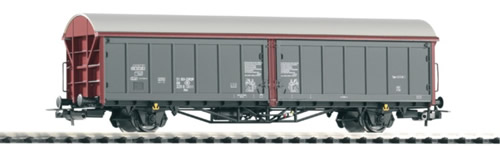
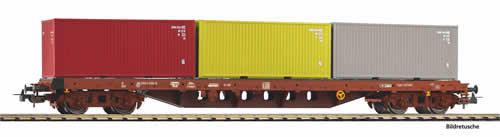
Flat car Rmmns SNCB
Road number: 31 88 397 1045-2
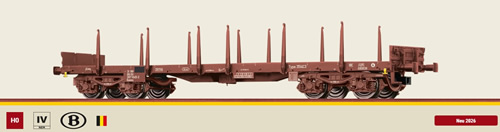
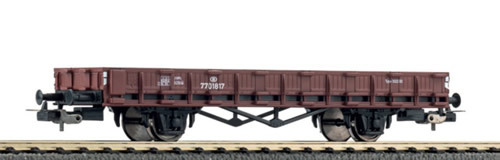
The UIC standardised a flat car as the UIC standard type 2 with a loading length of 12.64 m and a length over buffers of 14.04 m. The car was ordered by almost all European railway companies, both with and without side walls. From 1968 onwards, the Deutsche Bahn ordered a total of 2695 type 663 and 664 cars with side walls and 660 type 665 cars with side walls. The Deutsche Bahn wagons were special because their side walls were made of aluminium, while other European railway companies preferred side walls in steel. Most of the wagons purchased by the Deutsche Bahn are still in use, though several modifications have been made. Some have been fitted with type Y25 bogies and some have been converted into container cars.
Axle holders made of embossed sheet metal - Individually mounted wheelchocks - Individually mounted brake switch - Finely engraved details - True to original car bottom - Wheelsets with inside contours - Insertable stakes
With authorisation SNCB-NMBS Train World Heritage.
Our price -
€ 56,90
ORDER HERE
|
Brawa 49633
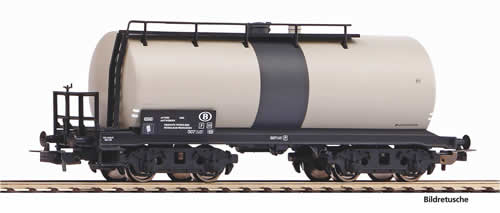
Tank Car Uerdingen ZZ [P] SNCB
Road Number: 921768
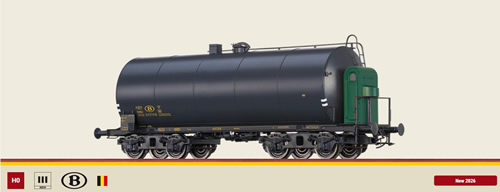
In 1939/40, the Köln-Deutz (Cologne-Deutz) and Uerdingen wagon factories each constructed a quadruple axle tank wagons in a lightweight design. Directly related to this, Westwaggon also manufactured the prototype of the tub-style tender, with which the war locomotives belonging to the BR 42 and 52 were coupled. The development was primarily driven by the military since it was necessary to transport enormous amounts of crude oil and fuels for replenishment purposes. As was the case with all war designs, the lightweight design was fully utilised in order to maximise the potential of the available steel quota. However, it soon became apparent that this was done to the detriment of the durability. At this point, both manufacturers were developing wagons with self-supporting tanks. Whilst Deutz left it at puffer beams, the Uerdinger design also boasted solebars manufactured from bevelled profiles that were intended to contribute in absorbing longitudinal compression forces. The main data of both versions was identical: The length over buffers amounted to 12.40 m, the bogie pivot distance amounted to 6.60 m and the tank contained 63 m3. As a result of the compact design, this amount lead to axle and metre load problems, meaning that it was not possible to completely fill the tank on all routes. Pressed sheet metal bogies with a 2.00 m wheel base were used as the running gear. The wagons that were built up until 1945 were deployed at "Wifo" (scientific research community) and oil associations in order to supply the German Armed Forces. After 1945, various European companies reproduced the wagons in a more advanced form, as did Tatra in Prague in 1946. In 1955, SEAG supplied almost 500 units of the wagons developed from the Uerdingen design to the United States Transportation Corps (USTC). Due to the war, many wagons were lost or remained in the territories of other European state railways . The wagons located in the catchment area of the western occupation zones made their way to VTG, which emerged from the former "Wifo" in 1951. In addition to this, mineral oil companies deployed further wagons in the form of P wagons and emerged as main tenants of the VTG wagons. The wagons that stayed with DR remained in the inventory of the state railway and were only leased out on a long-term basis, primarily to PCK Schwedt/ Oder in this case. The last wagons were only removed from the inventory in the 1990s and were being used as maintenance cars or station wagons. In this guise, they could still be regularly seen after the turn of the millennium.
Bogie with three-point support - Individually mounted wheelchocks - Individually mounted brake systems - Metal wheels - Finely engraved bogies brake shoes in wheel plane - Individually mounted axle brake rod
With authorisation SNCB-NMBS Train World Heritage.
Our price -
€ 46,00
ORDER HERE
|
Brawa 50071
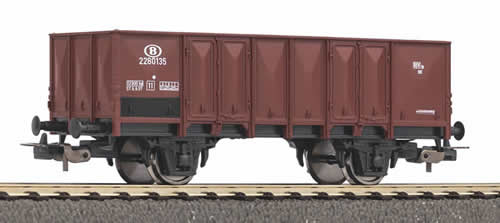
Open Freight Car 11 SNCB
Road Number: 2289004
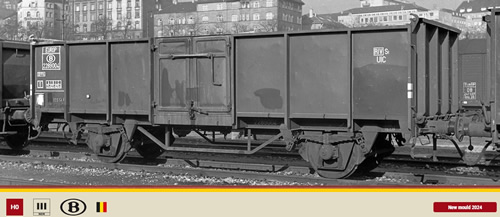
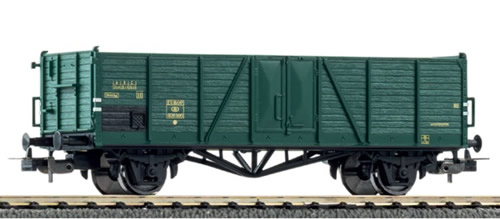
To promote the renewal of rolling stock and the standardisation of goods wagons among European state railways, the UIC (Union Internationale de Chemins de Fer) designed two variants of an open goods wagon at the beginning of the 1950s: the UIC Type I and UIC Type II. The UIC Type II closely adhered to the dimensions of 10.0 metres in length with a 5.4-metre wheelbase, drawing strong inspiration from pre-war German designs. The entire frame and wagon body were constructed using welded techniques. Upon completing the detailed design, the Federal Railway began upgrading its O-rolling stock at the Kaiserslautern workshop, using the UIC Type II as a basis. From 1954, 10,589 wagons of the Omm 54 types were produced in Kaiserslautern in just two years. Although officially considered conversions based on usable parts from older wagons, these wagons were largely built from new materials. An exception was the brake components, for which Kkg brakes from donor wagons were utilised. In the subsequent construction batches – designated as Omm 55 – these brakes were also dispensed with and new KE brakes were installed, resulting in the procurement of over 17,300 units from 1955 onwards. Through numerous detailed improvements during production as well as later design changes, the vehicles were maintained throughout their lifecycle and were not completely retired until 1994. In addition to the Federal Railway, other state railways also procured wagons based on the UIC Type II specifications for their fleets. These were deployed by the DR Ost (East German Deutsche Reichsbahn), SNCF, SNCB, FS, MAV, ÖBB (Austrian Federal Railways), SBB, CSD, DSB and others, each featuring country-specific details or components.
Lots of design differences - Variants with handbrake - Lots of extra details - Wheels profiled on both sides - Car floor of metal - Different versions of the brake systems - Three-point bearing for safe operation - Achshalter aus Metall - Side doors with inside contours
With authorisation SNCB-NMBS Train World Heritage.
Our price -
€ 47,50
ORDER HERE
|
Brawa 50072
Open Freight Car E SNCB
Road Number: 01 88 501 8 610-2
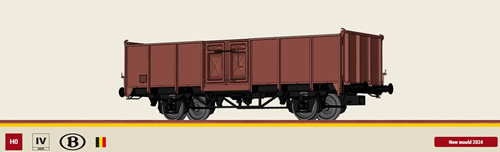
To promote the renewal of rolling stock and the standardisation of goods wagons among European state railways, the UIC (Union Internationale de Chemins de Fer) designed two variants of an open goods wagon at the beginning of the 1950s: the UIC Type I and UIC Type II. The UIC Type II closely adhered to the dimensions of 10.0 metres in length with a 5.4-metre wheelbase, drawing strong inspiration from pre-war German designs. The entire frame and wagon body were constructed using welded techniques. Upon completing the detailed design, the Federal Railway began upgrading its O-rolling stock at the Kaiserslautern workshop, using the UIC Type II as a basis. From 1954, 10,589 wagons of the Omm 54 types were produced in Kaiserslautern in just two years. Although officially considered conversions based on usable parts from older wagons, these wagons were largely built from new materials. An exception was the brake components, for which Kkg brakes from donor wagons were utilised. In the subsequent construction batches – designated as Omm 55 – these brakes were also dispensed with and new KE brakes were installed, resulting in the procurement of over 17,300 units from 1955 onwards. Through numerous detailed improvements during production as well as later design changes, the vehicles were maintained throughout their lifecycle and were not completely retired until 1994. In addition to the Federal Railway, other state railways also procured wagons based on the UIC Type II specifications for their fleets. These were deployed by the DR Ost (East German Deutsche Reichsbahn), SNCF, SNCB, FS, MAV, ÖBB (Austrian Federal Railways), SBB, CSD, DSB and others, each featuring country-specific details or components.
Lots of design differences - Variants with handbrake - Lots of extra details - Wheels profiled on both sides - Car floor of metal - Different versions of the brake systems - Three-point bearing for safe operation - Achshalter aus Metall - Side doors with inside contours
With authorisation SNCB-NMBS Train World Heritage.
Our price -
€ 47,50
ORDER HERE
|
Brawa 51016
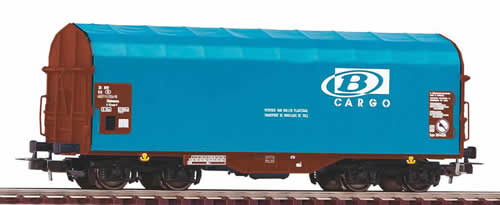
Covering Hood Car Shis Type 3614B0 SNCB
Road number: 31 88 437 3137-9
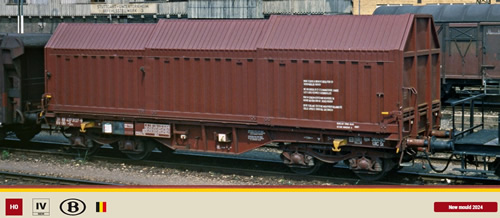
Due to the rolling process during their production, sheet steel coils are susceptible to moisture. In the 1970s, seeking to protect such coils from corrosion during transport to processing industries, the rail vehicle industry developed a special type of flatcar with three nested sliding hoods – the Shis 708, which was also known as the Shimmns 708 from 1987 onwards. To allow easy loading of the coils, the hoods can be opened as required, exposing the five loading troughs embedded in the vehicle frame. The Federal Railway placed orders for over 2,500 units of Shis/Shimmns 708 in two major batches. The actual number of vehicles of this design is significantly higher due to additional orders from other state railways and leasing companies. As the hoods became increasingly maintenance-intensive with age, DB AG replaced them with sliding tarpaulins on 1,000 carriages and reclassified these vehicles as the Shimmns-ttu 772 from 2002 onwards. However, private operators continue to utilise some vehicles in their original condition.
Sliding hoods not movable - Lots of design differences - Variants with parking and handbrake - Lots of extra details - Three-point bearing for safe operation - Different bogies of several types - Variant-appropriate arrangement of the address boards
With authorisation SNCB-NMBS Train World Heritage.
Our price -
€ 52,50
ORDER HERE
|
Brawa 51154
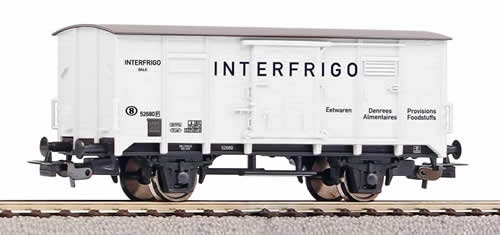
Refrigerator Car Ibces "Interfrigo" SNCB
Road Number: 11 88 083 0 067-7 [P]
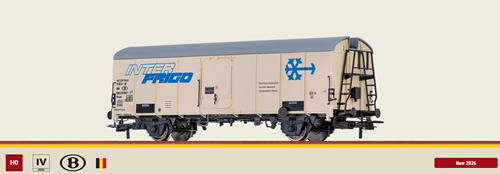
The international railway association UIC incorporated two refrigerated cars in its proposals for standardised car construction types. The Standard 1 (St.1) has today become the most common refrigerated car. The national railway in Greece, Morocco, Italy, Switzerland, France, the Netherlands and Belgium purchased ST. 1 refrigerated cars. Private St. 1 cars belonging to the Interfrigo Company were also operated on the Deutsche Bundesbahn network. Meat companies, breweries and food retail chains took these cars out of service. A total of around 6.500 cars were built.
Metal axle bearing - Bogie with three-point support - Multi-part brake system - Brake blocks in wheel plane - Tip bearing wheelsets - Individually mounted railing
Interfrigo is a registered trademark.
With authorisation SNCB-NMBS Train World Heritage.
Our price -
€ 45,50
ORDER HERE
|
Brawa 51162
Lightweight Tank Car Uerdingen Z [P] "Tankwagon Anvers" SNCB
Road Number: 506128 [P]
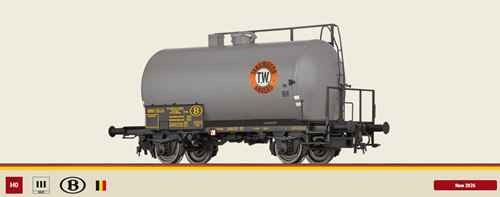
30m³ lightweight tank wagon in Uerdinger design – thanks to general technical advances in lightweight construction and welding technology, the management at the National Railway (Reichsbahn) decided to dispense with the actual vehicle frame when designing new tank wagons. Instead, the tensile and impact forces would, as far as possible, be absorbed by the boiler. Through the extensive use of welding technology, the goal was to reduce the raw-material requirements and manufacturing costs while at the same time obtaining more robust vehicles. For this reason, the wagon factory in Uerdingen received an order in 1938 to develop a lightweight tank car with a cargo volume of 30m³. As early as 1939, the three prototypes were handed over to two private goods-wagon rental companies as well as the state’s economic research association (Wirtschaftliche Forschungsgesellschaft (Wifo)) for testing. Following a small intermediate series in 1940, series production of the 30m³ Uerdinger-type lightweight tank wagon began in 1941. The largest customer was the German air force (Luftwaffe) with approx. 2,200 units, followed by the Wifo and many smaller companies, which resulted in a total of around 3,700 cars being built. In the post-war period, the wagons acquired by the Wifo and Luftwaffe were redistributed to other wagon operators in both German states. In the following decades, the wagons were primarily used by larger companies in the mineral oil industry, and also by smaller private companies as well as DB and DR themselves. Some of the wagons also remained abroad, where they were operated by new owners. In 2016 one of these wagons was still in use in internal interfactory traffic at Haltermann in Hamburg.
Bogie with three-point support - Individually mounted axle box cover - Individually mounted wheelchocks - Individually mounted brake systems - Finely engraved bogies - Brake blocks in wheel plane - Individually mounted axle brake rod - Free standing handle bars
With authorisation SNCB-NMBS Train World Heritage.
Our price -
€ 42,70
ORDER HERE
|
Brawa 51344
Heavy Duty Freight Car SSl SNCB
Road number: 372573
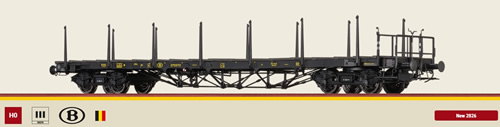
The railway has always been a means of transporting large and heavy loads. It was therefore a logical step for the K.E.P.V., after various predecessor designs, to devote itself to the development of rail carriages with larger payloads from around 1910. In accordance with the needs of the time, a rail carriage type was developed that was designed for a loading length of 18 m and a maximum load capacity of 35 t. In various construction lots between 1912 and 1928, the K.P.E.V. – and later the DRG – ordered a total of around 2,650 SSlm (Ce 168) rail carriages based on the Ce 168 master drawing. The filigree strut bracing and carriage floor made of perforated sheet metal were distinctive features of the rail carriages of this era. While most of these carriages were only equipped with handbrakes upon delivery, the units delivered to the DRB were factory fitted with Kunze-Knorr goods-train air brakes. These brakes were retrofitted to many carriages of older manufacture over the years. The vehicle fleet has fluctuated over the years. After the First World War, the total stock was decimated as a result of reparations to France and Belgium, as well as Poland. In the early 1950s, both German state railways still had a combined inventory of approximately 1,000 SSlm 16 / SSlu vehicles. Due to further decommissioning, the number of serviceable carriages fell steadily until the last wagons of this type were withdrawn from service in the 1970s.
Brake blocks in wheel plane - NEM-standard short-coupling - Die-cast zinc floor - Insertable stakes, individually enclosed - Delivery without load - Extra mounted steps and handrails - Metal wheels - Finely detailed chassis - Extra mounted axle brake rod - Individually mounted toe bearing
With authorisation SNCB-NMBS Train World Heritage.
Our price -
€ 71,50
ORDER HERE
|
Treinshop Olaerts